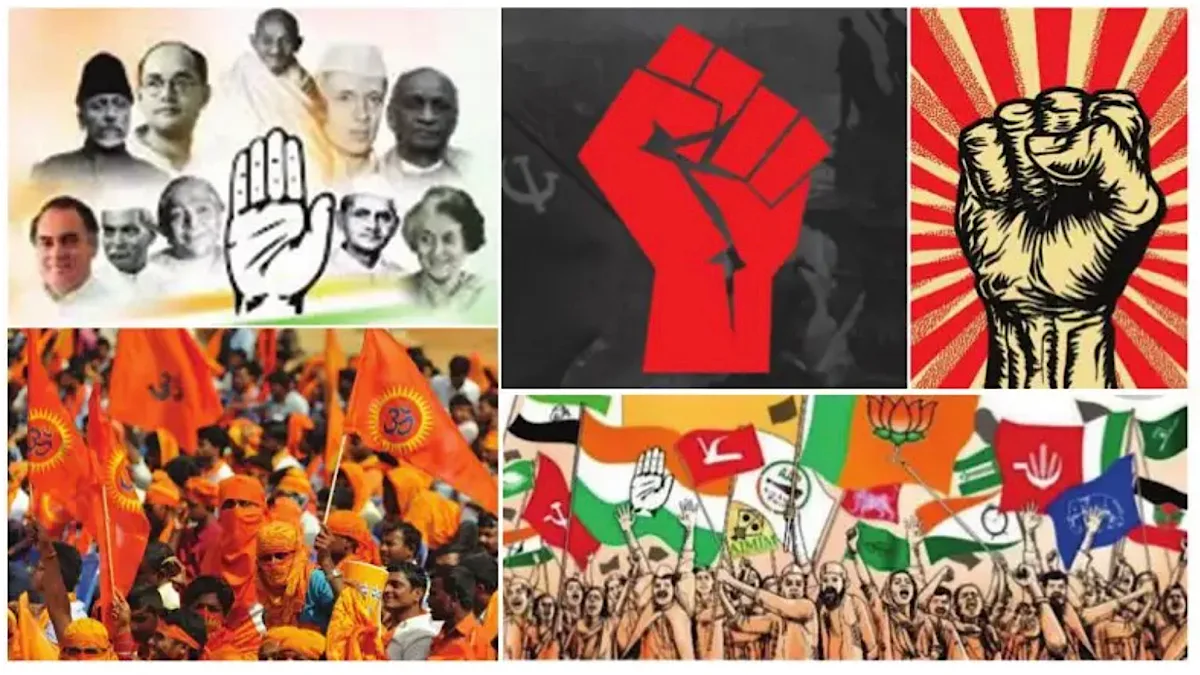
The greatest characteristic of Indian politics has been that ideological struggles here have always been multi-layered. Since the freedom movement, different conceptions of nationalism, secularism, socialism, cultural identity, and democracy have competed with one another. Yet for a long time, an ideological consensus prevailed that Indian democracy could be protected only by keeping Hindu nationalist politics outside the mainstream. In later decades, this very issue became one of the greatest controversies in Indian politics. Journalist Ravish Kumar once stayed at the home of Amit Shah while reporting in 2007.
In 2019, he replayed that interview and remarked that the lives of political leaders are very interesting: no one knows when someone becomes a book and when merely a footnote in a book. In 2007, Amit Shah was contesting elections in Gujarat under the leadership of Narendra Modi, and at that time his home carried a deeply religious atmosphere. Amid images of Hindu deities hung a portrait of Mahatma Gandhi. At the Centre, Manmohan Singh was serving his first term as Prime Minister. Very few people at that time could have imagined that this experiment in Gujarat politics would later alter the direction of national politics.
Advertisement
In Indian politics, regional developments have often later become the basis of national discourse. Gujarat was one such phase. There, an attempt was made to combine administration, Hindu identity, development, and organization into a single framework, and gradually this evolved into an alternative political model. Until then, Delhi’s political establishment largely believed that only those parties that operated within the Nehruvian consensus could remain permanently influential at the national level. The rise of the BJP challenged that consensus. Between 2007 and 2019, the political landscape of India changed dramatically.
The BJP became firmly established at the Centre and was expected to win even more seats in subsequent elections. It indeed achieved extraordinary success. If this story is extended to the present day, one could say that the BJP has continued to strengthen itself. Political forces opposing it are now speaking of building a broader united front. This essay attempts to reflect upon some aspects of the politics of these nearly twenty years. An analysis of Indian political history suggests that five major streams have remained active over the last hundred years: the Indian National Congress, leftistideology, socialist ideology, the localized politics of regional parties, and Hindu nationalist ideology.
The first four were generally considered part of the “Indian ideological” framework. Though they competed with one another, they still accepted each other’s legitimacy. Apart from them stood the fifth stream ~ the one rooted in Hindu nationalist thought. The first four differed among themselves, yet all of them tended to regard the fifth as alien or incompatible. Is Hindu nationalism really an alien political ideology? Were the thoughts of Vinayak Damodar Savarkar a threat to national unity? Did the Rashtriya Swayamsevak Sangh lay the foundations of division between Hindus and Muslims?
Was the Hindu Mahasabha an ideology that divided the nation from within? Did all these together encourage fascist forces in India? From 1947 to 1989, the influential political and intellectual establishment generally answered these questions in the affirmative. For them, anyone speaking in terms of Hindu political interests was viewed as acting against the national interest. On this issue, influential sections of the Congress, the Left, socialists, and regional politics often appeared united. The fifth stream remained marginalized. Between 1948 and 1989, even Indira Gandhi described Atal Bihari Vajpayee as a fascist in Parliament.
The dominance of what may be called the “Indian ideology” continued in one form or another until 2007. There were brief periods, particularly between 1977-79 and 1999–2004, when it seemed challenged. Supporters of this ideological framework believe that certain leaders enabled “fascist forces” to gain legitimacy in Indian politics. First among them is Ram Manohar Lohia, who advanced anti-Congress politics. Then came Jayaprakash Narayan, under whose leadership the Janata Party was formed with the aim of removing Indira Gandhi from power by any means possible. Supporters of the “Indian ideology” believe that because of Jayaprakash Narayan, the Jana Sangh was accepted for the first time as a legitimate ally within mainstream politics.
The third “villain” in this narrative is George Fernandes. After the Janata Party fragmented, he entered into alliance politics with the BJP and later became an important leader within the NDA. After him came Mamata Banerjee. For a long time, sections of the Left in West Bengal held her responsible for the BJP’s initial political presence in the state. A fifth example is Nitish Kumar. Two other leaders ~ Karpoori Thakur and Mayawati ~ were also, from time to time, accused of legitimizing the Jana Sangh or BJP. But one must pause here and consider a fundamental question: were relations between Congress and Hindu nationalist organizations hostile from the very beginning? The honest answer would be no. Until 1927, the Hindu Mahasabha often held its sessions alongside those of Congress. Usually, the president of one organization was respected on the other platform as well. In the 1930s, under Savarkar’s influence, the Hindu Mahasabha adopted a more independent line, yet later Syama Prasad Mukherjee maintained dialogue with Congress leaders.
Gandhi and Mukherjee generally shared cordial relations. As for Madan Mohan Malaviya, little needs to be said. Within Congress too, many senior leaders maintained contacts with Hindu nationalist figures. Names that readily come to mind include Sardar Vallabhbhai Patel, C. Rajagopalachari, Rajendra Prasad, Govind Ballabh Pant, Kanhaiyalal Munshi, and Bidhan Chandra Roy. Between 1946 and 1950, Syama Prasad Mukherjee even served as a minister in the Interim Government. The real rupture accelerated after Gandhi’s assassination. Thereafter, the Hindu Mahasabha and the RSS increasingly came to be viewed through the same lens. It was argued that these organizations represented Hindu communal politics and posed a threat to national unity.
From this point onward, the tradition of calling Hindu nationalist politics “fascist” became far more aggressive. Critic Namvar Singh once observed that along with history, the meanings of words also change. The word “fascist” too has changed over time. At one point, Muhammad Ali Jinnah even called Jawaharlal Nehru a fascist. In the 1940s, especially among people associated with the communist ideology, it became common to describe the Hindu Mahasabha and RSS as fascist. After Gandhi’s assassination, this accusation intensified further. The reasons behind such political polarization also deserve examination. Within the Congress itself, tensions between the right wing and the Nehruvian faction had existed since 1934. Conservative Congress leaders were comparatively softer towards Hindu nationalists.
After Gandhi’s assassination, the group close to Nehru also exerted pressure on the conservatives. Even Sardar Patel was morally blamed for Gandhi’s assassination, and demands were raised for his resignation. For Patel, who was deeply shaken by Gandhi’s death, this was extremely painful. At that time, Hindu nationalist organizations were very weak. Gandhi’s assassination had emotionally shaken the entire country, and anyone associated with it found it difficult to defend themselves. Many Hindu nationalists were imprisoned. For a long time afterward, simply invoking Gandhi’s assassination was considered sufficient to discredit them
(The writer is Professor of History, Rabindra Bharati University)